Evaluator Agents and Human-in-the-Loop
By Bhavesh Amin on 04 July 2026
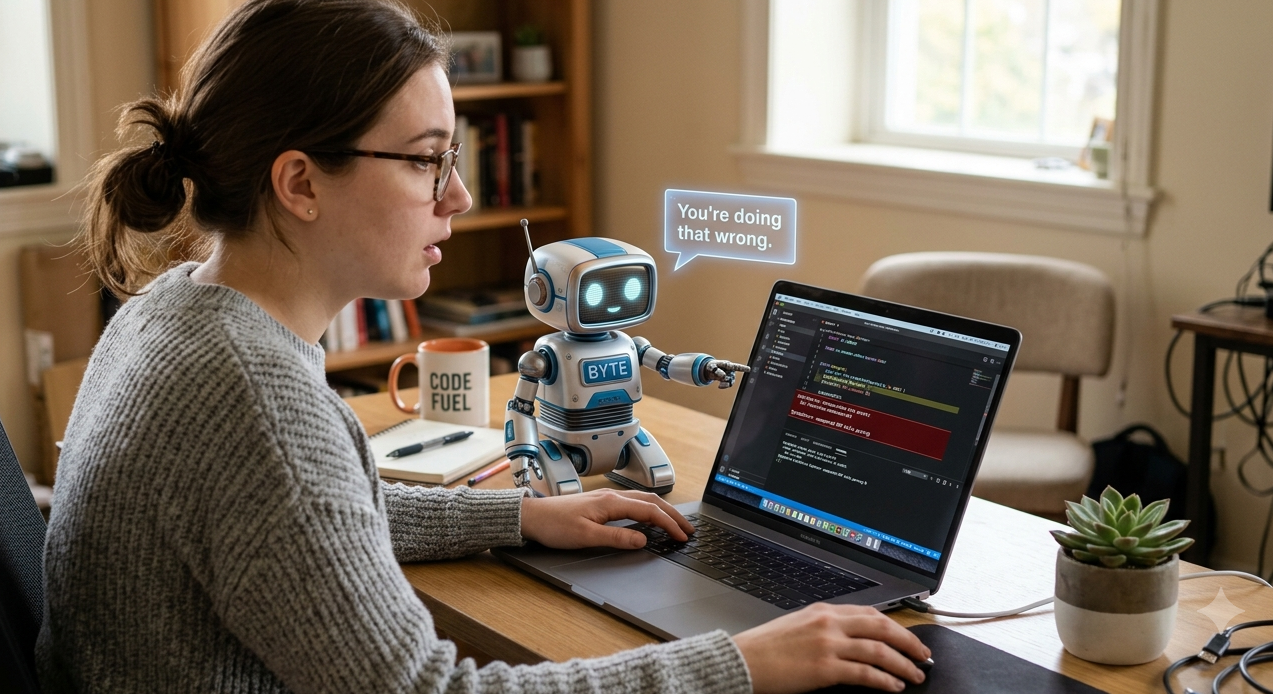
There is a reason why I grouped evaluator agents with human-in-the-loop. Both are useful, and one is more important than the other. Evaluator agents check the results another agent has produced and either provide feedback to the original agent to correct any errors or move the results to the next part of the workflow.
Evaluator Agents
Adding an evaluator agent to your workflows generally improves the accuracy of the results and reduces the chances of hallucinations. The evaluator’s system prompt includes instructions to check the worker agent's output, the criteria to check against, and actions to take based on the results of those checks. You provide the evaluator agent with the relevant tools and resources to carry out its checks.
An example of an evaluator agent is as follows:
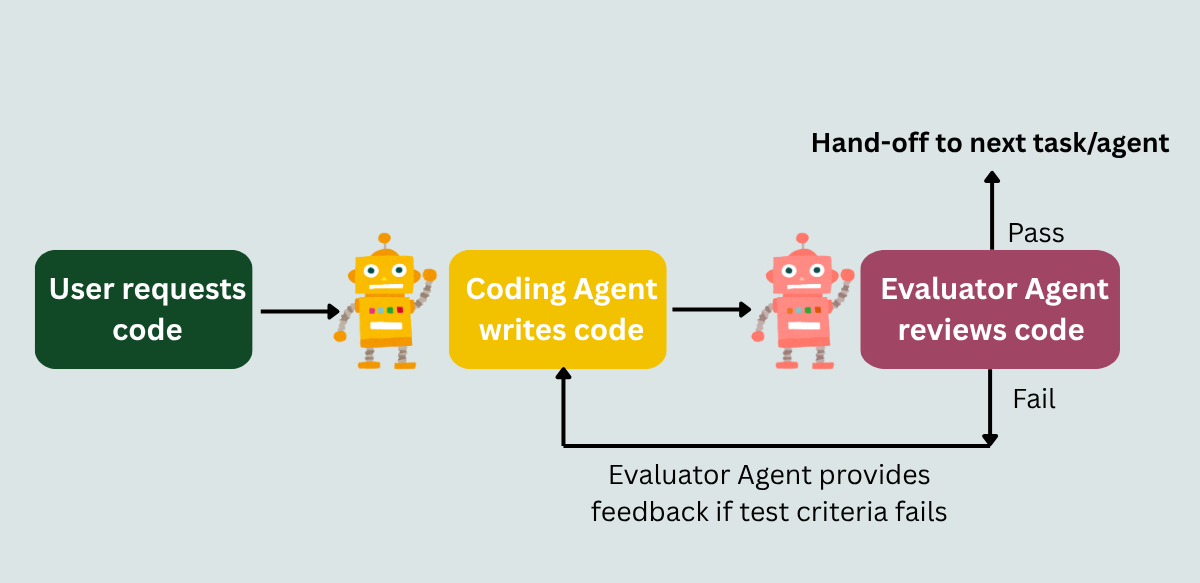
Figure 1: An evaluator agent example
In this example, an agent writes code based on the user prompt, and the second agent checks that it works as specified. The evaluator agent passes feedback if the code fails the test criteria or hands off to the next step in the process if the code passes the test criteria.
How an evaluator agent checks the worker agent’s results should, in my opinion, resemble how a peer reviewer or tester would check the results. I don’t see too much value in the evaluator agent redoing the worker agent’s task because you’re effectively duplicating the process if the worker agent is successful. If not, then you could be running agents through the same task three or four times.
Here are my three tips for making an effective evaluator agent:
- Use a different methodology to check the output of the worker agent. Be specific on what you want the evaluator agent to check.
- Try to use a different family of models for the evaluator agent compared to the worker agent. If you have used Claude models for the worker agent, try OpenAI models for the evaluator. This is useful if the evaluator task is similar to the worker agent task (i.e. you couldn’t find a different methodology for the checking task).
- Limit the number of feedback iterations to stop the process from becoming stuck in a loop. If after 2-3 attempts by the worker agent to implement the task doesn’t work, the evaluator should hand off to a human operator.
Let’s take an example of preparing sales data for a machine learning model. The idea is to use the current year’s data from a regularly updated transactional database to refresh the model every month. There are three steps before the data can be run through the model:
- The current year’s data is extracted from the database.
- There are rules to deal with blank or unknown data for the different features.
- The transactional sales data is crunched by all the relevant features.
So where do the evaluator agents come in? In this example, it’s probably more straightforward than others, as there will be user checks that the evaluator agent can do instead. Below is what the evaluator agents could check:
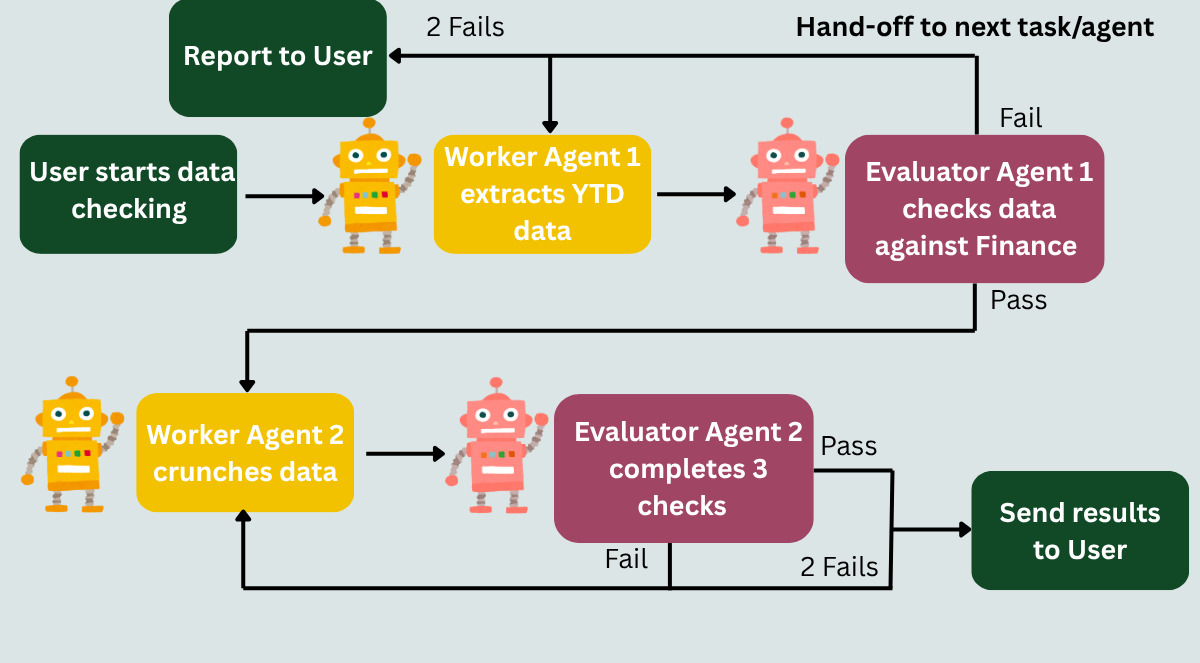
Figure 2: A possible data wrangling workflow
Worker Agent 1: Extract the current year’s data from the sales database.
Evaluator Agent 1: Cross reference the year-to-date figures with official figures from Finance. Are they within agreed tolerances? If they are not, provide feedback to Worker Agent 1, else hand off to Worker Agent 2.
Worker Agent 2: Implement the agreed rules to deal with blank or unknown data for each feature. Then sum the transactional sales data by all the relevant features.
Evaluator Agent 2: Create sales distributions for each feature. Carry out the following checks:
- Is the sum of sales for each feature the same? If it is not, suggest which feature distribution should be rerun.
- Compare the distributions to the previous year. Are there any differences outside tolerance levels? If so, feed back to Worker Agent 2 the factors to re-engineer.
- Do the total sales match the results from Worker Agent 1? If not, provide feedback to Worker Agent 2 that the sum of sales has changed from the previous step.
The system can monitor the number of times a worker agent has to redo work and limit the number of worker-evaluator loops, passing on failed checks to a human. Remember to monitor the failure rates and total costs of running the workflow and update the estimated ROI based on the test runs.
Now, say if your team creates a near perfect system, with no need for human intervention for the last three months. There may be the temptation to remove all human monitoring of the system. There are many reasons why this would be a bad idea.
Human-in-the-loop
The first reason why removing human monitoring is regulatory. If your company provides products or services to the EU, then your company may have to comply with the EU AI Act. If the AI system you’re building or modifying is categorised as high-risk, then Article 14 states there must be human oversight to check that the results are correct.
The second reason why human sign-off is important (even for a system that is performing perfectly) is that tools can change, agents can start to tackle tasks differently, models need to be changed, agents evolve from their system prompt, and hackers could infiltrate systems. You may decide some systems need less human oversight, and agents can document results to enhance the checking process, but the final human sign-off is still very important.
The third reason to include humans in the system is that they may speed up the whole workflow. If there are unstable parts of your agentic workflow, human intervention and checks at key stages of the workflow can improve the average speed of completing the task correctly. Monitoring failure rates for each step can help identify which steps should involve human checks before having a final sign-off. In the above example of the evaluator agent for data cleansing, you may find that having a human worker review the distributions is important, as they may spot anomalies that agents are missing.
The future of human-in-the-loop
While the message from AI companies has urged the importance of human involvement in AI workflows, OpenAI took a different approach with their initial agreement with the US government over the use of its technology for military applications . This was a deal Anthropic refused because of the potential risk of their models being used for mass surveillance and fully autonomous weapons. Sam Altman mentioned that OpenAI doesn’t get to make operational decisions (for the military), which offers insight into where we might end up with human intervention in AI systems. Legislation is one way to ensure responsible use of AI, but politicians’ rhetoric on less red tape and deregulation will likely dilute its impact. Ethically responsible companies are another way to share best practices across their industries, but they need an equal footing, which can only be achieved with robust legislation.
Final thoughts
Evaluator agents are useful tools to keep an agentic AI workflow running on the right path, while human-in-the-loop is essential to build trust and meet legislation requirements. Getting evaluator agents working is where you can start to see the return on investment. Agentic AI can feel a bit pointless if you constantly have to correct your agents’ output, and there will be times where your team will think the agent is close to producing the desired outcome. It is important to remember the capabilities and limitations of LLMs and the tools. For example, calculations were a no-go area for earlier versions of LLMs because the models predict tokens and do not compute mathematical formulae. Now, with access to Python tools, an LLM can perform quite well with calculations.
Human-in-the-loop is a vital element to the agentic AI process, and I’d like it to still be a vital part of agentic AI systems in the future and not just turn into a cursory glance tick-box exercise as AI, as with other tools, make mistakes. But knowing people and the factors that drive company decision-making, it seems likely that the human-in-the-loop will be replaced by evaluator agents.